If you’ve spent even five minutes searching the internet for mental health support, you have probably read something pretty close to this phrase:
“Cognitive Behavioural Therapy (CBT) is a talking therapy based on the concept that your thoughts, feelings, physical sensations, and actions are interconnected.”
It is everywhere. It is on medical websites, therapist directories, and self-help blogs. But if you’re sitting there thinking, “Okay… but what does that actually mean in real, everyday life?” — you are not alone.
Let’s strip away the textbook jargon and talk about what CBT actually is, how it works, and why it isn’t nearly as clinical or scary as it sounds.
The “Interconnected” Thing (In Plain English)
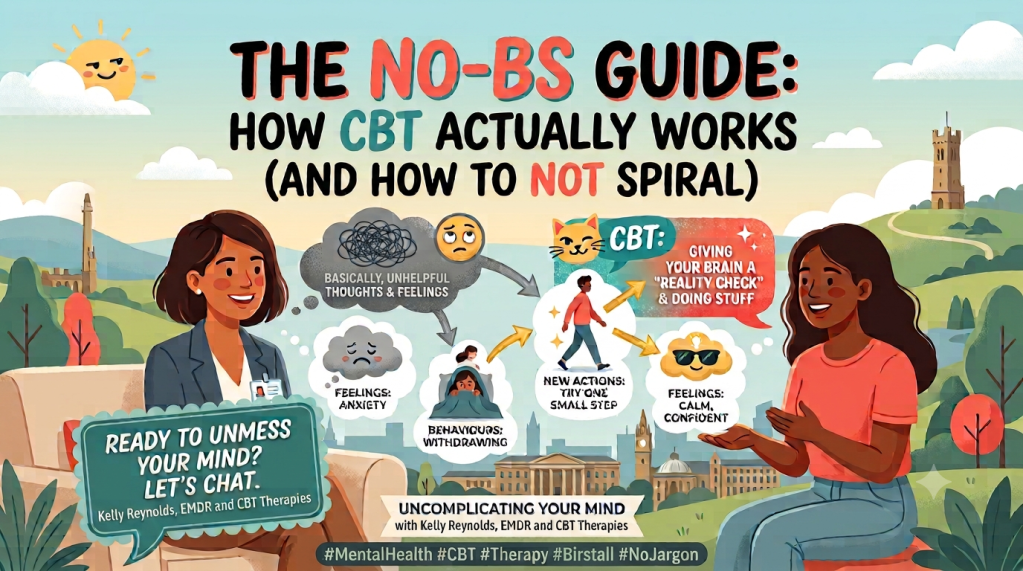
Essentially, CBT is based on a very simple truth: how you think affects how you feel, which affects what you do.
They aren’t separate compartments in your brain; they form a continuous loop.
Imagine you send a text to a friend, and three hours go by with no reply.
- The Thought: “They’re mad at me. I must have said something wrong.”
- The Feeling: Anxiety, sadness, a sinking feeling in your stomach.
- The Behaviour: You withdraw, delete social media from your phone, or send an angry follow-up text.
Now, imagine the exact same situation, but with a different thought:
- The Thought: “Ah, they’re probably busy at work or forgot their phone charging in the kitchen.”
- The Feeling: Calm, indifferent.
- The Behaviour: You shrug it off and get on with your day.
The situation (the unread text) didn’t change. Your thought changed, which completely rewrote your feelings and your behaviours. CBT is simply the toolkit that helps you notice these loops and change the thoughts that are dragging you down.
Let’s Talk About “Negative Automatic Thoughts” (NATs)
This is one of those clinical terms that sounds incredibly intimidating.
If you look up the formal definition, a psychologist might tell you that NATs are:
“Involuntary, stream-of-consciousness cognitions that are primed by negative core beliefs and present as absolute truths.”
Sounds terrifying, right? Like some sort of glitch in your brain’s operating system.
But in real terms, it’s much simpler than that. Negative automatic thoughts are just thoughts your mind has without you actively thinking them. They literally just pop into your head.
If that sounds alarming, take a deep breath. Your mind pops random thoughts into your head all day long that mean absolutely nothing!
Think about it:
- You’re walking down the street.
- You see a cat.
- Your brain instantly pops up the thought: “Kitty!”
- You keep walking. You don’t analyse it, you don’t worry about why you thought it, and you don’t spiral. It just came and went.
A negative automatic thought works the exact same way. It’s just that instead of “kitty!”, the thought that pops in is “I can’t do this” or “I’m going to fail.”
It doesn’t make the thought true. It doesn’t mean anything. It is a completely normal experience that every single human on this planet goes through.
Why We Spiral (And How CBT Helps)
If these thoughts are so normal, why do they cause us so much distress?
It’s because of how we react to them. A thought only has as much power as the meaning you give it.
If a negative thought pops up and you let it drift on by, it disappears. But if you grab onto it, inspect it, worry about it, and let it stay… it starts to grow. What started as a tiny, random thought can quickly spiral into a full-blown bad day.
Learning to just let those thoughts go sounds easy in theory, but in practice, it can be really hard. Our brains are hardwired to pay attention to negative things to “keep us safe.”
That is exactly where CBT comes in.
CBT doesn’t try to stop you from ever having a negative thought again (that’s impossible!). Instead, it teaches you the practical, real-world strategies to identify those thoughts when they pop up, recognise them for what they are (just thoughts, not facts), and let them pass without spiralling.
But What Do Behaviours Have to Do With It?
It’s one thing to tell yourself, “Okay, a thought isn’t a fact.” It’s another thing entirely to actually believe it.
If I sat here and insisted to you that pigs can fly, you wouldn’t just take my word for it. You’d (rightfully) want some proof. Your brain works the exact same way. If your brain has spent years telling you, “You’re going to mess up that presentation,” simply replying, “No I won’t, that’s just an automatic thought” usually isn’t enough to convince it. Your brain wants hard evidence.
That is where the Behaviour part of CBT comes in.
Instead of just talking about changing your thoughts, CBT helps you act like a scientist in your own life. Together, we come up with new, small ways of behaving when a negative thought pops up, and then we test them out to see what actually happens.
For example, if your brain says:
“If you join that group project, everyone will think your ideas are stupid.”
Instead of doing what you usually do (staying quiet and hiding in the back), we might decide on a small “experiment” where you share just one idea.
Afterwards, we chat about it:
- What actually happened?
- Did they laugh, or did they listen?
- How did acting differently affect your feelings?
By gathering real-world proof that your negative thoughts aren’t always right, your brain starts to rewire itself. You get to decide what you want to do with that thought, how you want to act, and how you want to handle it the next time it pops up.
Ready to Break the Loop?
At the end of the day, CBT isn’t about forcing yourself to be positive all the time, and it isn’t about overcomplicating your mind with clinical jargon. It’s about giving you real, practical tools to take back control from those unhelpful, automatic loops. You don’t have to figure it out alone, and you definitely don’t have to let those thoughts run the show.
If you’re ready to start breaking old patterns, click here to send me a WhatsApp message or drop me an email at enquiries@kr-therapies.co.uk. Let’s chat about how we can work together to make your mind a much easier place to live in!
About the Author
Kelly Reynolds, EMDR and BABCP, Accredited Cognitive Behavioural Therapist
I’m Kelly, a qualified EMDR and CBT therapist based in Birstall, West Yorkshire. My passion is stripping away the stuffy, clinical talk of therapy and helping real people find practical, everyday strategies to quiet their busy minds and build lives they truly enjoy. When I’m not working with clients, you can find me at gigs, car shows, listening to music or with my head in a book.
Disclaimer: This blog is for educational and informational purposes only. It is not a substitute for professional medical advice, diagnosis, or psychological treatment.

